ENVIRONMENTAL MONITORING
Real‑Time Insight for Uptime, Efficiency & Infrastructure Protection
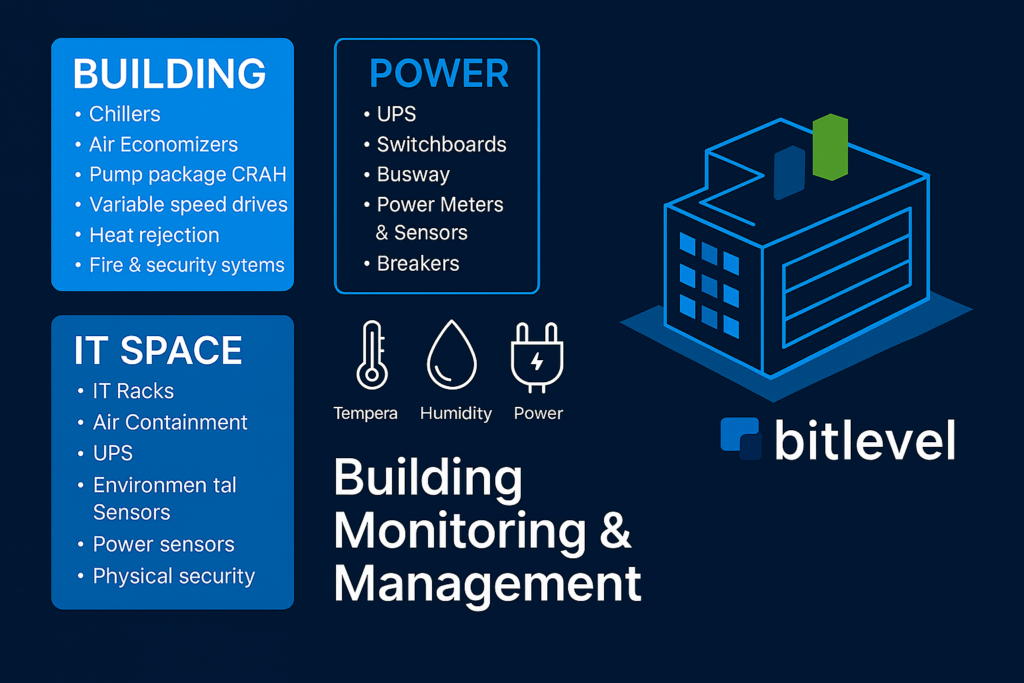
Environmental Monitoring for Data Centres
Environmental monitoring is a critical component of modern data centre management. By continuously tracking conditions such as temperature, humidity, airflow, particulates, power load, and more, operators gain the visibility required to maintain uptime, protect IT assets, and ensure energy‑efficient operation.
With advanced platforms like DCIM (Data Centre Infrastructure Management) and facility monitoring integrations, Bitlevel delivers real‑time environmental intelligence engineered specifically for mission‑critical environments.
Our solutions enable operators to prevent outages, optimize cooling, reduce energy consumption, and maintain compliance — all while safeguarding infrastructure from environmental risks.
At bitlevel, we offer cutting-edge environmental monitoring solutions that provide seamless integration of these systems to ensure a more sustainable and optimized facility.
What Is Environmental Monitoring in a Data Centre?
Environmental monitoring in a data centre involves the continuous measurement and analysis of operational variables across IT rooms, white space, mechanical areas, and power systems.
Key metrics include:
- Temperature
- Humidity
- Airflow and pressure
- CO₂ and air quality
- Power consumption and load distribution
- Water leaks and moisture levels
- Rack‑level hot spots
- PDU/UPS/cooling performance
Real‑time insight into these conditions enables operators to maintain consistent thermal performance, prevent equipment stress, and optimize energy usage.
How DCIM, BAS & FMS Enhance Data Centre Environmental Monitoring
Although Bitlevel focuses primarily on data centre‑grade monitoring, we leverage three core technologies when integrating with larger facility environments.
- DCIM (Data Center Infrastructure Management) — Core to Data Centre Monitoring
DCIM provides deep visibility into critical infrastructure systems, including:
Cooling systems
Power distribution
Thermal conditions
Energy usage
Rack‑level environmental sensors
DCIM detects anomalies, predicts failures, and optimizes capacity.
Example
A DCIM system identifies a thermal hot spot in a specific rack and automatically instructs cooling resources to adjust, preventing downtime and extending equipment lifespan.
- BAS (Building Automation Systems) — For Data Centres in Larger Facilities
For data centres located within commercial or enterprise buildings, BAS integrates larger building systems, including:
HVAC
Electrical systems
Chillers and air handlers
Environmental controls
This allows automated adjustments based on real‑time environmental feedback.
Example
If the data centre load increases, BAS can adjust chilled water valves or airflow to support increased cooling requirements.
- FMS (Facility Monitoring Systems) — Holistic Facility-Wide Insight
FMS connects mechanical and electrical subsystems to provide a complete operational view that supports:
Predictive maintenance
Facility‑level energy management
Compliance reporting
FMS ensures the mechanical plant supporting the data centre operates efficiently and reliably.
Example
FMS detects humidity fluctuations in a mechanical room feeding the data centre and triggers corrective action before conditions impact the IT space.
Key Benefits of Real‑Time Environmental Monitoring for Data Centres
- Improved Operational Efficiency
Environmental monitoring data helps optimize:
Cooling distribution
Airflow
Rack load balancing
IT power allocation
This ensures the data centre runs efficiently, reducing wasted energy and operational costs.
- Proactive Issue Detection
24/7 live monitoring identifies issues such as:
Overheating
High humidity
Blocked airflow
Failing fans
Power irregularities
Water leaks
Identifying these problems early prevents outages and protects IT hardware.
- Better Energy Efficiency & Sustainability
Data‑driven control reduces:
Energy waste
Overcooling
Mechanical strain
Carbon footprint
This supports ESG initiatives and improves overall PUE.
- Compliance & Reporting
Data centres benefit from automated reporting to support:
Internal audits
SLA tracking
Capacity planning
Regulatory compliance
Client transparency (colocation)
- Enhanced Uptime & Risk Reduction
Environmental monitoring allows instant reaction to dangerous conditions, such as:
Sudden temperature spikes
Cooling failures
UPS overloads
Water ingress
This dramatically reduces the risk of outages and service interruptions.
Environmental Monitoring Use Cases for Data Centres
✔ IT White Space
Temperature, humidity, airflow, rack hot spots, and equipment stress.
✔ Mechanical Areas
CRACs, CRAHs, chillers, pumps, cooling towers and air distribution performance.
✔ Electrical Rooms
UPS load, PDU performance, breaker health, battery runtime, and grounding integrity.
✔ Colocation Tenant Spaces
Per‑rack or per‑suite environmental monitoring for SLA compliance and transparency.
✔ Edge & Micro Data Centres
Lightweight environmental monitoring to support remote or unmanned sites.
Why Choose Bitlevel for Environmental Monitoring?
Seamless Integration with DCIM
Complete visibility of your thermal, power, and environmental conditions through one platform.
Real‑Time Analytics
Instant insights help you make faster, smarter operational decisions.
Energy Optimization
Reduce cooling costs, optimize airflow, and lower PUE.
Scalable & Flexible Systems
From single data halls to multi‑site hyperscale environments.
Sustainability & Compliance
Support internal sustainability goals and maintain audit‑ready reporting.
Conclusion
Environmental monitoring is essential for maintaining uptime, protecting infrastructure, improving efficiency, and supporting sustainability initiatives in data centres.
By integrating DCIM, BAS, and Facility Monitoring Systems, Bitlevel delivers real‑time insight, proactive issue detection, and end‑to‑end operational control.
Our technology helps data centres run:
Faster
Safer
Cooler
More efficiently
With complete visibility
Let bitlevel help you deploy a modern, intelligent environmental monitoring solution tailored to mission‑critical operations.
Contact us today to optimize your data centre environment.
Revenue Grade Metering for Tenant Billing in Data Centres
In Ontario, revenue grade sub-metering for data center colocation refers to the precise metering of electrical consumption at a granular level (usually at the rack or tenant level) within a shared data center facility. This sub-metering system ensures that electricity usage is measured accurately, so colocation tenants can be billed fairly based on their individual power consumption. These meters must meet specific Ontario regulations and industry standards to qualify as “revenue grade” for billing purposes.
Key Elements of Revenue Grade Sub-Metering in Ontario:
- Compliance with Ontario Energy Regulations:
- Revenue grade meters used in Ontario must comply with the Ontario Energy Board’s (OEB) regulations and the Electricity Act, 1998. These regulations ensure that the meters used in billing are accurate, reliable, and meet the standards required for utility billing.
- The OEB sets guidelines for the installation, maintenance, and operation of metering systems that are used for sub-metering in commercial settings, including data centers. Revenue-grade meters must comply with these OEB standards for accurate billing.
- Metering Standards:
- In Ontario, the meters used for sub-metering must adhere to the Measurement Canada guidelines and comply with the Canadian Standards Association (CSA) and International Electrotechnical Commission (IEC) standards, such as IEC 62053-22 or ANSI C12 standards for accuracy.
- These meters are designed to provide a high level of precision, typically within 1% accuracy, which is crucial for accurate billing.
- Sub-Metering and Billing Transparency:
- Sub-metering allows data centers to allocate energy costs based on actual usage by each tenant rather than sharing the overall facility’s electricity bill. Each customer or tenant is assigned their own sub-meter that tracks their specific power consumption.
- In Ontario, sub-metering data must be made available to tenants in a clear and understandable format, enabling them to monitor their consumption in real-time and optimize their usage.
- Ontario Energy Board’s Role:
- The OEB oversees the rules for sub-metering in Ontario, ensuring that tenants are billed according to the actual energy they use. Sub-metering for data centers must adhere to OEB’s Retail Settlement Code and Code of Conduct for sub-metering.
- These regulations protect consumers by ensuring that billing is transparent, and that no hidden fees are passed on by the data center provider.
- Types of Sub-Metering Systems:
- For data center colocation environments, sub-metering systems are typically digital meters that track energy consumption per rack or tenant. These meters provide the data needed for detailed billing and usage analysis.
- The systems may also include energy management software that integrates with the meters, providing real-time energy data, historical consumption trends, and predictive analytics.
- Advantages for Tenants and Providers in Ontario:
- For Tenants: Revenue grade sub-metering offers fair, transparent, and accurate billing. Tenants only pay for the energy they consume, and they can use real-time data to monitor and optimize their energy usage.
- For Providers: By using accurate revenue-grade meters, data center operators ensure they meet regulatory requirements, avoid disputes, and maintain transparent relationships with tenants. Providers can also manage energy costs more effectively by monitoring usage patterns.
Practical Example in Ontario:
Imagine a data center in Ontario that has multiple tenants renting rack space. Each tenant has their own server equipment, which consumes a specific amount of electricity. The data center installs revenue-grade sub-meters on each tenant’s power supply line. The electricity consumption of each tenant is recorded accurately, and the data center uses this information to bill each tenant based on their individual usage. This process ensures that the data center complies with Ontario’s regulations, and tenants are only billed for the energy they use.
Conclusion:
In Ontario, revenue grade sub-metering in data center colocation environments is an essential system that ensures fair and accurate billing for electricity usage. These meters must comply with stringent regulatory standards set by the Ontario Energy Board and Measurement Canada. The system allows for granular tracking of energy consumption at the tenant level, providing transparency for both providers and tenants and ensuring that each party is billed fairly based on actual consumption.